Key Takeaways
- Global vs local pathways – IGCSE enables direct access to international universities; SPM remains essential for Malaysian public university entry
- Subject flexibility – IGCSE offers 70+ subjects for specialisation; SPM follows fixed national curriculum
- Cost differences – IGCSE requires RM 20,000-60,000 annually; SPM costs minimal but often needs supplementary tuition
- Assessment styles – IGCSE combines coursework with exams; SPM emphasises final exam performance
- University doors – IGCSE opens international pathways; SPM ensures local university eligibility
Introduction
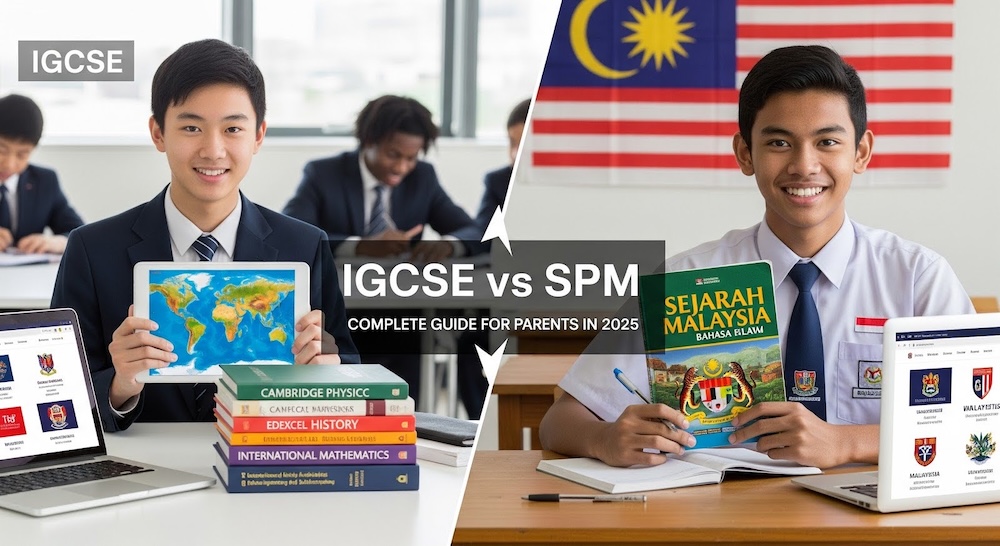
In 2025, choosing between IGCSE and SPM shapes whether your child follows a direct pathway to global universities like Cambridge and Oxford, or progresses through local routes including foundation programmes and STPM. With Malaysian families increasingly seeking global opportunities and university competition intensifying worldwide, this decision carries unprecedented weight for your child's future.
Both qualifications provide secondary education pathways, yet they differ fundamentally in curriculum design, global recognition, assessment methods, and long-term opportunities. Understanding these differences is crucial for families navigating Malaysia's diverse educational landscape.
This comprehensive comparison examines real university admission requirements, financial implications, and career outcomes to help you make an informed choice.
At Crescendo-HELP International School (CHIS), our
Secondary Curriculum demonstrates how the Cambridge IGCSE pathway prepares students for both local and international university success.
IGCSE vs SPM: A Quick Comparison Table (2025)
| Decision Factor |
IGCSE (Cambridge) |
SPM (Malaysia) |
University Impact |
| University Access |
Direct pathways to UK, US, Australian universities |
Primarily Malaysian institution recognition |
IGCSE opens more international doors |
| Local Public University Entry |
Requires SPM Bahasa Melayu for IPTA admission |
Standard requirement for all public universities |
SPM mandatory for government university access |
| Subject Flexibility |
70+ subjects, early specialisation possible |
Fixed national syllabus with mandatory subjects |
IGCSE allows targeted university prerequisite planning |
| Annual Education Investment |
RM 20,000-60,000 (international schools) |
Minimal in government schools |
Cost difference reflects different pathway values |
| Assessment Approach |
Coursework + examinations reward analytical thinking |
Examination-focused, emphasises memory and technique |
Different preparation for university study styles |
Note: IGCSE is offered by three examination boards: Cambridge Assessment International Education, Pearson Edexcel, and Oxford AQA. CHIS follows the Cambridge International pathway, the most globally recognised variant, ensuring consistent progression from IGCSE through to A-Levels.
IGCSE vs SPM Syllabus: Curriculum and Subjects
Here's the fundamental difference: IGCSE empowers students to tailor their education, whilst SPM provides structured national standards that ensure consistent outcomes across Malaysia.
IGCSE (Cambridge Syllabus)
Subject Range and Flexibility:
- 70+ subject options across sciences, arts, languages, business, and technology (subject availability depends on school offerings)
- Students typically study 7-9 subjects, with flexibility to combine disciplines
- No compulsory Bahasa Melayu or Sejarah requirements
- Strong emphasis on coursework, practicals, and analytical components
SPM (National Syllabus)
Core Requirements:
- Mandatory subjects: Bahasa Melayu, Sejarah, Mathematics, Science, English
- Muslim students take Pendidikan Islam; non-Muslims study Pendidikan Moral
- Students usually complete 9-12 subjects in designated streams (Science, Arts, Technical)
- Entirely examination-based assessment with minimal coursework
Real-World Example: Consider Ahmad, interested in engineering. Through IGCSE, he selects Physics, Chemistry, Additional Mathematics, and Computer Science—precise targeting for engineering prerequisites. Under SPM's science stream, he studies these subjects but with less flexibility to combine creative subjects like Art & Design with pure sciences.
At CHIS, our
Cambridge Secondary Curriculum allows this strategic subject combination whilst maintaining academic excellence.
IGCSE vs SPM Assessment: Which Prepares Students Better
IGCSE Assessment:
- Grading: A*–G (or 9–1 depending on board)
- Methods: Written exams, coursework, practicals, oral components
- University preparation: Develops research, analysis, and independent learning skills
SPM Assessment:
- Grading: A+–G with national benchmarks
- Methods: Examination-focused with minimal continuous assessment
- Skills: Builds revision techniques and performance under pressure
Bottom Line: IGCSE's diverse assessment mirrors international university styles, whilst SPM's examination focus suits local higher education. Consider your child's target destination when choosing.
At CHIS, our
Cambridge Secondary Curriculum develops both analytical thinking and examination excellence.
University Doors: Which Qualification Opens More Opportunities?
IGCSE Recognition:
- Global access: Accepted by UK, US, Australian, Canadian universities
- Pathway: Direct progression to A-Levels, IB, or Foundation programmes
- Malaysian private universities: Accept IGCSE for Pre-University/ Foundation/ Diploma entry
- IPTA requirement: Still need SPM Bahasa Melayu and Sejarah passes
SPM Recognition:
- Local advantage: Essential for Malaysian public university (IPTA) admission
- Pathways: STPM, Matriculation, Pre-University/Foundation/ Diploma programmes
- International limitations: Often requires additional bridging programmes
Real Impact: Sarah's 6 IGCSE credits provided direct University of Melbourne foundation entry, whilst her friend's 8A+ SPM results required grade conversion and additional documentation.
At CHIS, our IGCSE graduates secure first-choice university places, demonstrating effective preparation for both local and international destinations.
Planning for A-Levels or Pre-University? At CHIS, we guide students seamlessly from IGCSE into Pre-University programmes such as our
A Level Programme, ensuring they are fully prepared for admission into top universities worldwide.
IGCSE vs SPM Fees: How much does IGCSE cost in Malaysia?
When considering secondary education investment, cost often becomes the deciding factor for Malaysian families. Here's what the numbers really mean:
| Cost Component |
IGCSE |
SPM (Public Schools) |
| Annual Tuition |
RM 20,000-60,000 |
Minimal, government subsidised |
| Examination Fees |
~RM 200-600 per subject |
Government covered |
| Resources & Materials |
Higher (imported textbooks, lab fees) |
Localised, subsidised materials |
| Additional Tuition |
Often integrated in school fees |
Frequently required: RM 200-800 monthly per subject |
The Real Cost Analysis
IGCSE Investment:
- Annual tuition encompasses comprehensive education delivery
- Smaller class sizes and specialist teachers included
- University guidance and A-Level preparation integrated
SPM Hidden Costs:
- Government school fees appear minimal but many families invest heavily in private tuition
- Total supplementary education costs often reach RM 15,000-25,000 annually
- Additional enrichment programmes to develop English proficiency and critical thinking skills
According to the Ministry of Education Malaysia's Private Education Statistics Report 2023, families increasingly invest in supplementary education to bridge curriculum gaps—costs that can approach international school fees over time.
Tip for Parents: Some schools, including CHIS, offer
Study Awards and Bursaries to reduce tuition costs for deserving students. This makes quality international education more accessible whilst maintaining academic excellence.
Which is Better for Careers: How Each Qualification Shapes Future Opportunities
Parents frequently ask how IGCSE or SPM influences career prospects in Malaysia's evolving economy and globally competitive job market.
SPM Career Advantages
- Essential for government positions, civil service, and public sector employment
- Valued by local industries requiring strong Bahasa Melayu proficiency
- Provides direct entry into vocational diplomas and local professional certifications
- Serves as a stepping stone to advanced qualifications through foundation or matriculation programmes, leading to careers in medicine, engineering, law, and finance
IGCSE Career Advantages
- Strong foundation for STEM careers, international business, and global industries
- Advantageous for careers in international corporations and roles requiring cross-border mobility
- Develops analytical skills and English proficiency crucial for professional advancement
- Creates pathways to advanced qualifications (A-Levels, IB) leading to medicine, engineering, law, and finance careers
Professional Insight: SPM remains essential for public sector roles, while in private and multinational settings, employers increasingly prioritise skills and English proficiency—areas where IGCSE graduates often excel.
How Parents Can Choose: Your Decision Framework
Rather than overwhelming families with complex criteria, focus on these three critical questions that determine optimal pathway selection:
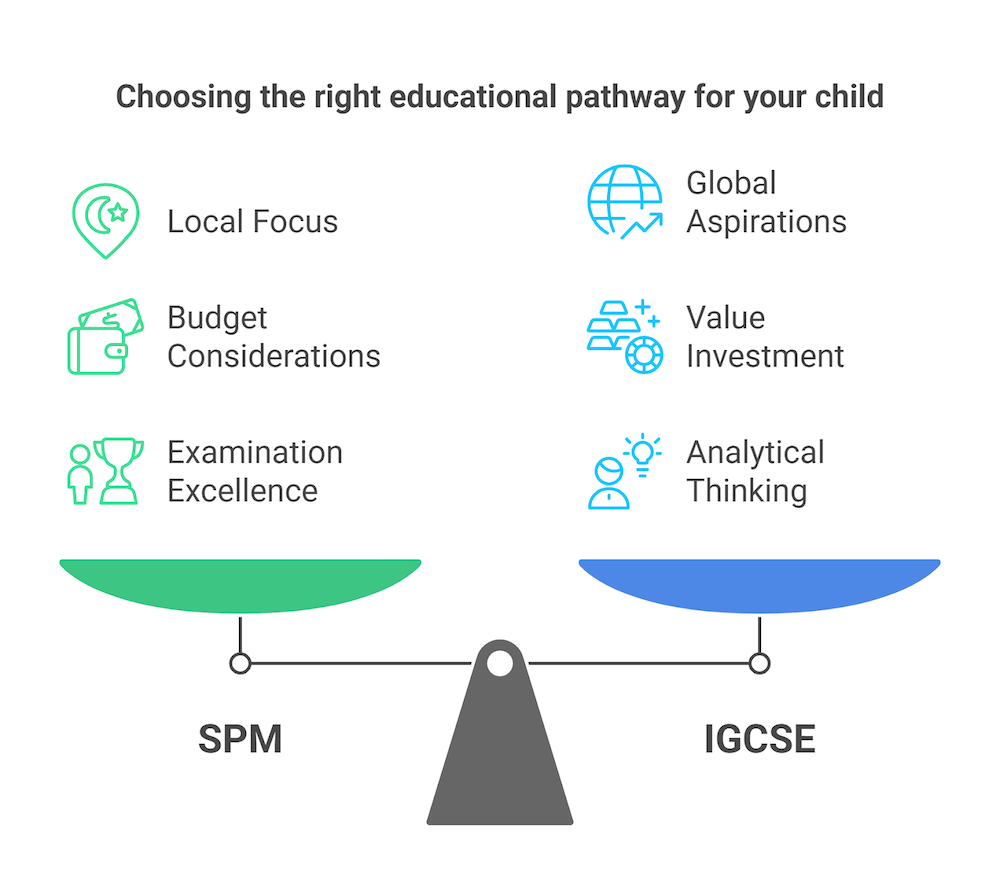
Question 1: Where Will Your Child Study?
- Local focus: If targeting Malaysian public universities and local career opportunities, SPM provides essential requirements and cultural alignment.
- Global aspirations: For international university pathways and global career opportunities, IGCSE offers superior recognition and preparation.
Question 2: What's Your Family's Educational Investment Capacity?
- Budget considerations: Government schools with SPM offer affordable baseline education, though supplementary investment often becomes necessary.
- Value investment: International schools with IGCSE require higher upfront costs but provide comprehensive education delivery and university preparation.
Question 3: How Does Your Child Learn Best?
- Examination excellence: Students who excel under pressure and demonstrate strong memory skills often thrive in SPM's assessment environment.
- Analytical thinking: Learners who prefer coursework integration, practical applications, and diverse assessment methods benefit from IGCSE's approach.
- Strategic Advice: Visit schools offering both pathways, observe classroom environments, and assess which teaching philosophy aligns with your child's learning style and academic strengths.
Making the Right Choice: Your Family's Path Forward
Both IGCSE and SPM can lead to university success and rewarding careers. The optimal choice depends on your child's aspirations, learning style, and your family's long-term goals rather than perceived prestige or difficulty levels.
For families seeking globally recognised education with strong academic outcomes and character development, CHIS offers the complete Cambridge pathway from
Primary through
A-Levels, ensuring seamless progression and university preparation excellence.
Your Next Steps:
- Clarify university targets – Local public institutions require SPM; international universities prefer IGCSE
- Assess financial investment capacity – Factor in total education costs over 5-7 years
- Evaluate learning styles – Match assessment approaches with your child's strengths
- Visit schools in person – Experience teaching quality and learning environments firsthand
If your family is considering IGCSE, the best way to decide is to
book a school tour at CHIS and discuss pathways with our Admissions team.
You May Also Find Helpful:
- IGCSE vs O Level: University Recognition Compared – Which qualification opens more doors for Malaysian and international university entry?
- IGCSE vs GCSE in Malaysia: Parent’s Complete Guide – Understand the key differences in curriculum, recognition, and pathways to make the right choice.
References:
FAQs: IGCSE vs SPM
Can my child take both SPM and IGCSE?
Yes, though balancing both syllabi creates significant workload challenges. Most families choose one pathway for focused preparation and better outcomes.
Do Malaysian universities accept IGCSE?
Private universities readily accept IGCSE for foundation and diploma programmes. Public universities require SPM Bahasa Melayu and Sejarah passes regardless of other qualifications.
Is IGCSE harder than SPM?
Different rather than harder. IGCSE emphasises analytical thinking and coursework integration; SPM focuses on examination technique and memory mastery. Difficulty depends on individual learning preferences.
What's the next step after IGCSE?
Students progress to A-Levels, IB Diploma, or university foundation programmes. The pathway choice depends on target universities and career aspirations.
Explore More CHIS Programmes:
International Primary School Johor Bahru |
International Secondary School Johor Bahru |
A Level Programme
Visit CHIS:
International School Johor Bahru