A-Level Scholarships Malaysia: What Types are Available (2026 Guide)
January 29, 2026

Key Takeaways

Students with strategic subject combinations aligned to university goals tend to perform better in scholarship evaluations, as schools prioritise readiness for both A Level study and future degree programmes.

- A-Level scholarships in Malaysia offer meaningful fee relief for students entering Pre-University (Year 12–13), where costs and academic pressure increase significantly.
- Scholarships are commonly school-based, with limited external options compared to undergraduate level.
- Academic merit remains the primary criterion, but subject combinations, consistency, and interview performance matter just as much as grades.
- Most scholarships are partial tuition awards, not full sponsorships, and should be assessed alongside total A-Level costs.
- Cambridge-based A-Level programmes typically provide more accessible scholarship pathways than premium IB routes.
- Schools like Cresendo-HELP International School focus on sustainable affordability, combining academic excellence, transparent fees, and structured financial assistance for families planning long-term.
Introduction
A-Level represents one of the most academically demanding stages of a student’s education. It is also among the most expensive, particularly at international schools offering Cambridge A-Levels, where programme intensity and subject specialisation drive higher costs. In Malaysia, annual A-Level fees typically range from RM25,000 to RM85,000, depending on school type, location, and subject offerings. For many families—especially those progressing from IGCSE—A-Level scholarships in Malaysia play a critical role in making Pre-University education financially sustainable. This focus on affordability reflects wider trends showing that families increasingly prioritise cost transparency, long-term value, and internationally recognised pre-university pathways when selecting A-Level programmes, particularly in markets like Malaysia where demand for international education continues to grow (British Council, Local Impact of Transnational Education, 2021). Beyond easing financial pressure, A-Level scholarships often serve as indicators of:- Academic readiness for university-level study
- Strong subject alignment with future degree pathways
- Access to structured academic support and university counselling
What Types of A-Level Scholarships are Available in Malaysia?
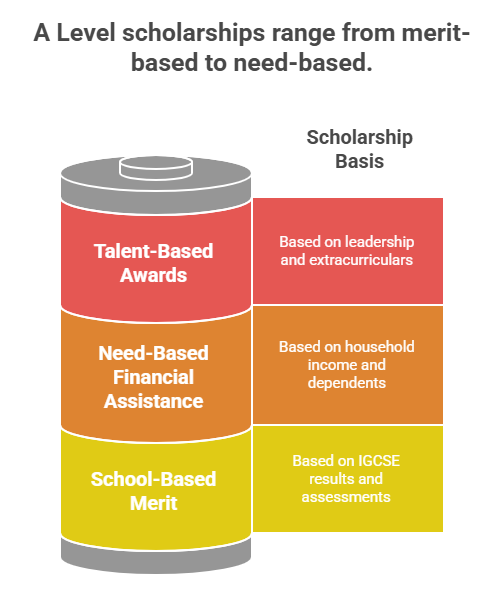
Unlike undergraduate education, A Level scholarships are mostly school-driven rather than externally funded. Below is a clear breakdown of the main types of A-Level scholarships available in Malaysia and what parents can realistically expect.
1. School-Based Merit Scholarships
These are the most common forms of A-Level scholarships in Malaysia. Typically awarded based on:- SPM/IGCSE results, or equivalent
- Entrance assessments
- Interview performance
- Subject suitability for A-Level
2. Need-Based Financial Assistance & Bursaries
Some international schools offer financial assistance or bursaries to families who demonstrate genuine financial need. Assessment may include:- Household income
- Number of dependents
- Long-term enrolment commitment
3. Talent or Leadership-Based Awards (Limited)
Unlike secondary levels, talent-based scholarships are less common at A-Level due to academic intensity. However, some schools may consider:- Leadership roles
- Outstanding extracurricular achievement
- School representation at national level
Who Is Eligible for A-Level Scholarships in Malaysia?
Eligibility criteria vary by school, but most institutions adopt a holistic assessment approach. Common Eligibility Requirements:- Strong IGCSE academic results
- English proficiency (Cambridge assessment standard)
- A-Level subject readiness
- Entrance tests or subject placement exams
- Interview performance and attitude
Which A-Level Subjects Are Most Favoured for Scholarships?
Scholarship decisions are influenced not only by grades, but also by subject relevance and academic rigour, particularly in relation to university entry requirements.| Subject Group | Scholarship Preference | Reason |
|---|---|---|
| Mathematics & Further Maths | High | Strong indicator of academic ability; essential for STEM and Finance. |
| Sciences (Physics, Chemistry, Biology) | High | Common university prerequisite subjects for Medicine, Engineering, and Tech. |
| Economics & Accounting | Moderate–High | Popular for business, finance, and professional corporate pathways. |
| Arts & Humanities | Moderate | Assessed alongside academic balance; critical for Law and Social Science. |
When Should Students Apply for A-Level Scholarships?
Timing is critical, especially for students completing IGCSE, as scholarship availability often decreases closer to intake.Typical A-Level Scholarship Timeline
- August–October (Year 11): Enquiries, assessments
- November–January: Interviews and offers
- February–March: Final confirmation
- April onwards: Limited late availability
How Competitive are A-Level Scholarships in Malaysia?
The level of competition varies depending on several factors, including:- School reputation
- Number of available scholarship places
- Scholarship coverage percentage
- Student cohort size
How Do A-Level Scholarships Compare to Total Pre-University Costs?
A-Level scholarships should never be assessed in isolation. While tuition discounts can significantly reduce headline costs, they represent only one part of the overall Pre-University investment. To plan realistically, parents should also account for:- Tuition fees after scholarship deductions
- Examination fees for individual A-Level subjects
- Subject-specific laboratory or material fees
- Registration fees and refundable deposits
Why Cambridge A-Levels Offer Better Scholarship Accessibility
Cambridge A-Levels remain one of the most scholarship-friendly Pre-University pathways in Malaysia, particularly for families seeking a balance between academic rigour and long-term value. This accessibility is driven by several key factors:- Clear academic benchmarks, allowing schools to assess readiness consistently
- Transparent grading standards, which support fair scholarship evaluation
- Strong global university recognition, increasing confidence in academic outcomes
- Lower programme overheads compared to IB, enabling schools to allocate more resources towards scholarships
Why Many Families Choose Cresendo-HELP International School for A-Level Scholarship Pathways
CHIS is positioned as a value-focused international school, balancing affordability, academic rigour, and strong pastoral care. Key strengths include:- Cambridge-aligned Primary, Secondary & A-Level pathways
- Structured financial assistance and bursaries
- Transparent fee structures with no hidden surprises
- Strong academic progression from IGCSE to Pre-University
- Supportive admissions and subject guidance for parents
How Parents Can Improve Their Child’s A-Level Scholarship Chances
Practical Preparation Tips
- Apply early and to more than one suitable school
- Ensure IGCSE subject choices align with intended A-Levels
- Prepare for interviews, not just exams
- Highlight consistency, not last-minute grade spikes
- Demonstrate commitment to the school’s academic pathway