Key Takeaways
- Johor Bahru is a rising education hub with international schools that often cost less than Kuala Lumpur and Singapore while offering global curricula.
- The best international school in Johor Bahru balances curriculum quality, experienced teachers, class size, well-being support, and transparent fees.
- British-based Cambridge pathways with inquiry-based primary programmes (such as IPC) give a clear route to IGCSE and A-Level with wide university recognition.
- Parents should compare accreditation, learning environment, commute, and long-term affordability, then visit campuses to test the real “fit” for their child.
Why Choosing the Best International School in Johor Bahru Matters?
More Malaysian and expatriate families now look across regions — and even across borders — when choosing schools. Johor Bahru (JB) stands out because it is close to Singapore, well-connected to other Malaysian states, and home to a growing cluster of international schools.
Enrolment in Malaysia’s international schools has risen steadily as families seek English-medium education and globally recognised qualifications. According to
ISC Research’s Malaysia Report 2025, the sector has recorded sustained growth in both student numbers and campus openings over recent years.
With more choice comes more complexity. Fee levels, curriculum labels and campus photos can look similar; what matters is how each school performs day-to-day for students and parents.
Why Johor Bahru Is Emerging as an Education Hub?
A strategic location for Malaysians and cross-border families
Johor Bahru serves three main groups:
- Local Johor families seeking alternatives to national schools
- Parents working in Singapore who prefer children to study in JB
- Expatriate families relocating to the Iskandar corridor
The city’s position in the Malaysia–Singapore corridor, plus ongoing economic collaboration, makes it attractive for families who want international education without the highest metropolitan costs.

Why some Singapore-based parents consider JB
For Singapore-based families, international schools in Johor Bahru can offer:
- Larger campuses and more open space
- A calmer schooling environment
- Potentially lower annual fees and living costs
For these parents, the best international school in Johor Bahru is usually one that delivers recognised international qualifications, communicates clearly across borders, and offers stable routines that work with daily commuting patterns.
Curriculum Choices in Johor Bahru: Cambridge, IPC, IB and More
Comparing main curriculum options
Parents will typically encounter three broad curriculum types:
| Curriculum Type |
Key Features |
Often Best For |
| Cambridge (IGCSE & A-Level) |
Subject depth, exam-based assessment, global recognition |
Students targeting **UK, Malaysian and Commonwealth universities**, or who prefer structured exams |
| International Baccalaureate (IB) |
Broad, inquiry-based, strong emphasis on **coursework** |
Students who enjoy **research, reflection** and a wide subject mix |
| Hybrid / Other International |
Combination of international and local content |
Families wanting some **national elements** alongside international exposure |
Rather than looking for a single “best” curriculum, focus on how well each one fits your child. Helpful questions include:
- Where is my child likely to study after school?
- Does my child thrive with exam-based assessment, or with more coursework?
- How clearly does the school explain the journey from primary to pre-university?
The value of IPC and a British-based Cambridge pathway
Many parents in Johor Bahru choose a British-based Cambridge pathway paired with a primary framework that emphasises inquiry and themed projects, such as the International Primary Curriculum (IPC). This combination often provides:
- Engaging, thematic learning in the primary years, where children explore big ideas through connected units instead of isolated subjects
- A smooth transition into subject-based secondary schooling, because core skills in reading, writing, maths, and inquiry are built early
- Clear progression into IGCSE and A-Level, with a consistent British-based structure from primary through to pre-university
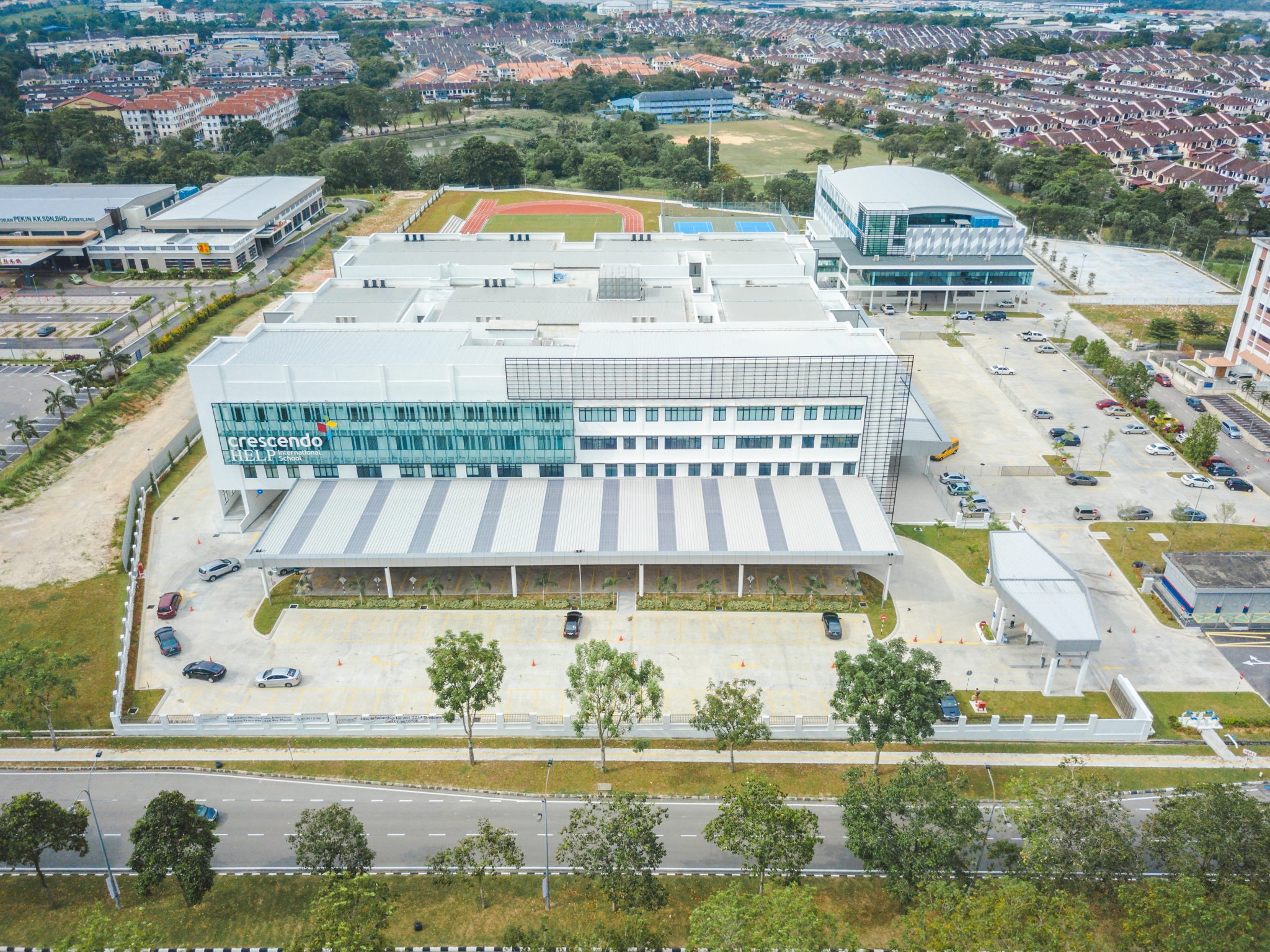
At Crescendo-HELP International School (CHIS), this approach is reflected in the way the
Primary Curriculum builds foundations, the
Secondary Curriculum develops subject depth, and
Pre-University prepares students for A Level success and university entry.
International School Fees: Johor Bahru vs Kuala Lumpur and Other States
Typical fee ranges in Johor Bahru
Exact figures differ by school, but parents in Johor Bahru can expect approximate annual ranges like:
| School Phase |
Indicative Annual Fees (RM) |
Notes |
| Primary (Years 1–6) |
~25,000 – 40,000+ |
Varies by curriculum, facilities and class size |
| Secondary (Years 7–11) |
~25,000 – 60,000+ |
Upper years often cost more due to exam support |
| Pre-University (Yr 12–13) |
~30,000 – 80,000+ |
Depends on subjects, class size and campus profile |
Johor Bahru tends to sit slightly below Kuala Lumpur for similar curricula, while still offering strong academic routes to IGCSE and A-Level. For cross-border families comparing with Singapore fees, JB can represent substantial savings.
For a more detailed, state-by-state breakdown of fees and typical hidden costs, see:
International School Fees in Malaysia 2025: Complete Guide & Comparison
How Johor Bahru compares with other regions
| Region |
Typical Fee Position |
Key Considerations |
| Kuala Lumpur / Petaling Jaya |
Highest range, widest variety |
Flagship campuses, premium brands, heavy traffic |
| Penang / Secondary Cities |
Slightly lower on average |
Fewer pre-university options in some locations |
| Johor Bahru |
Mid-to-high range, below KL premium levels |
Cross-border access, growing ecosystem of schools |
Aim to choose schools that offer the strongest overall value — high-quality teaching, manageable class sizes, supportive services, and fees that you can comfortably sustain over the long term.
Location, Campus and Cross-Border Practicalities
Daily commute considerations
A smooth, manageable daily journey helps your child enjoy school and learn at their best. When evaluating location:
- Check door-to-door commute times at actual school hours, not just off-peak.
- Ask about school transport, security at pick-up points and traffic flow at drop-off.
- For cross-border families, consider immigration timings and contingency plans for delays.
What a safe, welcoming campus looks like
During campus visits, observe:
- Controlled, visible security measures
- Calm movement of students between lessons
- Libraries, labs and creative spaces that are actively used
- Green or shaded areas and quiet zones for well-being

How to Shortlist and Evaluate an International School in Johor Bahru
Step 1: Clarify your non-negotiables
Agree on:
- Likely university destinations and preferred qualifications
- Language and cultural expectations
- A sustainable annual fee band
- Your child’s temperament and support needs
Step 2: Build a simple comparison shortlist
Create a straightforward comparison list for each candidate school, noting:
- Curriculum offered (Cambridge, IB, hybrid)
- Average class size and student–teacher ratio
- Key facilities (labs, sports, arts, ICT, music)
- Annual fees and major additional costs (transport, meals, uniforms, exams)
- Approximate one-way commute time during school hours
Step 3: Visit campuses and ask practical questions
During school tours, consider questions such as:
- “What is your average class size in primary and secondary?”
- “How do you support students who are new to English or to this curriculum?”
- “How often do students use specialist facilities?”
- “How do you communicate concerns or progress with parents?”
Notice the school culture and community:
As you walk around, observe how students interact with teachers and with each other.
- Do classrooms feel calm, respectful and inclusive?
- Are there visible student-led projects or leadership roles?
These small signals often say more about whether your child will feel at home than any brochure.
To learn more about a school,
book a school tour and admissions consultation to see how these questions are addressed in a real Johor Bahru setting.
Step 4: Check accreditation, results and destinations
Look for:
- Recognised curriculum accreditation and external quality assurance
- Strong teacher credentials and relevant training
- Multi-year exam performance, not just one standout cohort
- A spread of alumni destinations across Malaysian and overseas universities
Teacher credentials and school accreditation
Ask about
teacher credentials – subject-related degrees, recognised teaching qualifications and Cambridge/IPC/IB training. Then confirm the school’s accreditation: is it authorised to deliver its stated curriculum (e.g. Cambridge, IPC, IB), and when was it last externally reviewed?
Student outcomes and university pathways
When reviewing
student outcomes, look for multi-year IGCSE and A-Level results, a balanced spread of grades, and university offers in Malaysia and abroad. Ask for examples of
alumni success – scholarships, leadership roles or career paths – and how the guidance team supports applications.
Step 5: Run the long-term numbers
Before making a final decision, calculate:
- Projected fees for the next 3–5 years
- Estimated increases per year
- Additional costs (transport, meals, uniforms, exams, trips)
- Any bursaries or study awards that might apply
Read also
How to Choose the Best International School in Malaysia: A Parent’s Guide (2025) designed as a structured decision tool you can use alongside this Johor Bahru–specific guide.
When Might a Johor Bahru Cambridge & IPC School Be the Right Fit?
A Johor Bahru international school built around a British-based Cambridge pathway with an IPC-style primary approach may suit your family if:
- You want a clear progression from primary to IGCSE and A-Level with broad university recognition.
- You value inquiry-based primary learning that builds curiosity, not just rote memorisation.
- You prefer moderate class sizes and strong pastoral care, where teachers know students personally.
- Your family may move between Johor and Singapore and needs qualifications recognised on both sides of the border.
If this sounds close to what you’re looking for,
Crescendo-HELP International School (CHIS) is a useful reference point. At CHIS:
Together, these give you a practical picture of how a Cambridge & IPC-style Johor Bahru school can support your child’s learning journey and your family’s long-term plans.
Final Thoughts and Next Steps
Choosing the best international school in Johor Bahru is about finding a school that fits your child’s needs, your family’s values, and your long-term plans – not just picking the most expensive or the most well-known name.

As Johor Bahru matures into a regional education hub, families benefit from greater choice, particularly those balancing life between Malaysia and Singapore. The most confident decisions come from a clear comparison framework, reliable information and in-person campus visits.
Book a school tour and admissions consultation at CHIS today to see whether it feels like the right fit for your child.
FAQs – Best International School in Johor Bahru (2025)
1. Are international schools in Johor Bahru cheaper than in Kuala Lumpur?
Often slightly, for similar curricula and facilities, though fee bands overlap. Always compare specific schools and inclusions.
2. Is a British-based Cambridge curriculum better than IB?
Both are well recognised. Cambridge focuses on exam-based subject depth; IB emphasises breadth and coursework. The right choice depends on your child and future plans. Learn more about
Cambridge vs IB Curriculum (2025): Key Differences Parents Should Know.
3. Can my child move from a government school into an international school in JB?
Yes. Many students transition in upper primary or lower secondary. Schools usually assess English and Mathematics and may offer bridging support.
4. Will JB International School qualifications be recognised overseas?
Programmes like
IGCSE,
A-Level and the IB Diploma are widely recognised by universities worldwide, including in the UK, Australia and Singapore.
5. How early should I apply for a place?
It is sensible to enquire 6–12 months ahead, especially for entry points like Year 1, Year 7 and Year 10, where spaces fill quickly. Full details and contact options are available on
Our Admission Process.
6. What year levels does CHIS accept and when are the main intake points?
CHIS welcomes students from primary through to pre-university (A-Level), with key entry points typically at
Year 1,
Year 7 and
Year 10, as well as for the
A-Level intake. Limited places may also be available in other year groups, subject to assessment and space.
For the latest information visit our
Admission Process, or
speak to us today!
7. How do I start the application process with CHIS?
To begin, parents can
submit an enquiry,book a school tour, or apply online via the CHIS website. The admissions team will guide you through required documents, assessments and next steps, and advise on timelines for your preferred start date.
References:
ISC Research, Malaysia Report 2025. Available:
https://iscresearch.com/reports/malaysia/